
SHE KNOWS. SHE ACTS. · 07 · HER STORY
The first hour
Birgitte is 55 and has noticed stiffness in her shoulders and hips during the first hour each morning. This began a couple of months ago, and she worries people will just blame it on her age.
Julia PerssonFounder, Scita Health8 min read
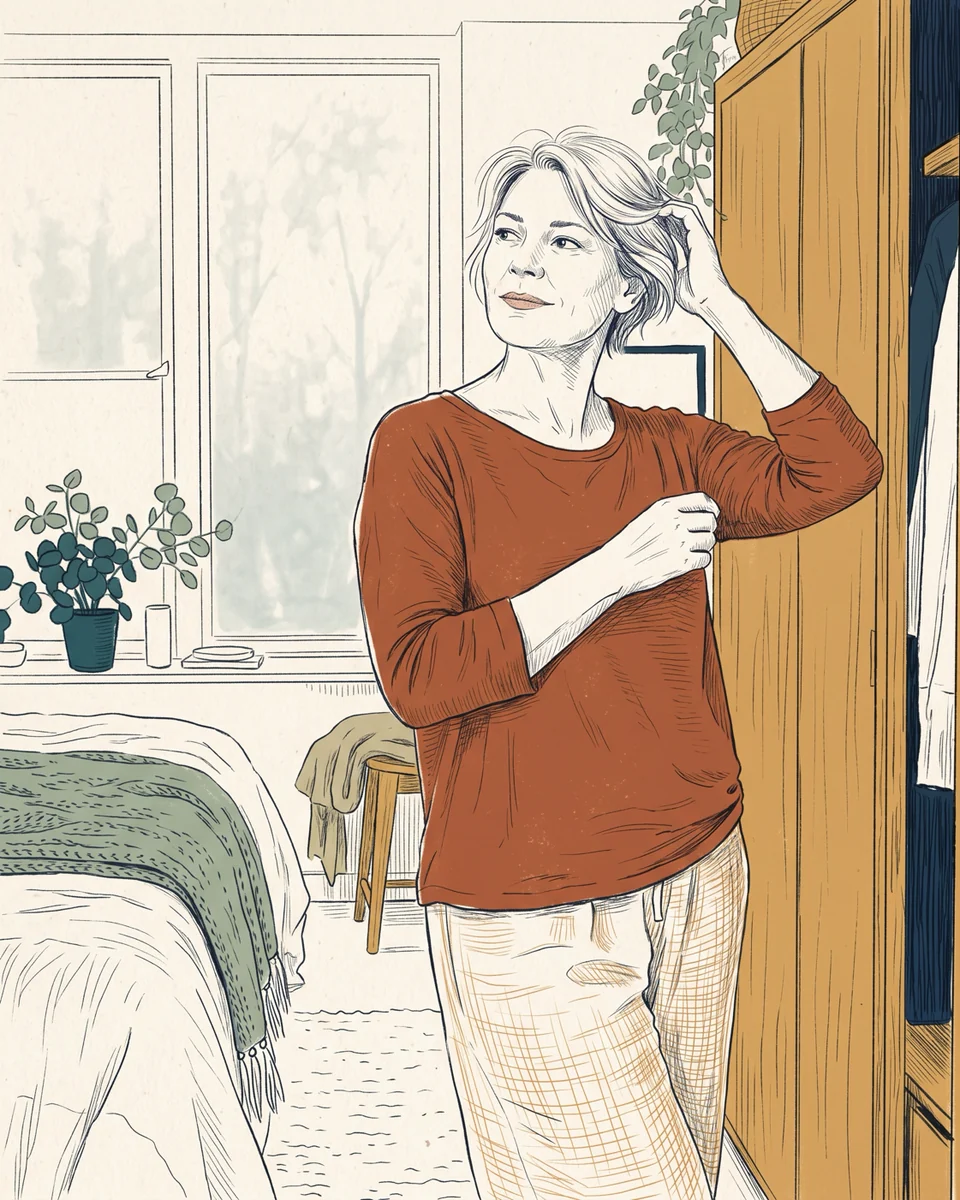
When Birgitte wakes up, her shoulders and hips are stiff, and it takes her more than one try to get out of bed. In the shower, she pauses before lifting her arms to wash her hair. On some mornings, she washes her hair in two steps, taking a break in between. The hardest part of getting dressed is pulling a jumper over her head.
After about an hour, most of the stiffness fades. Even so, she feels tired all day, no matter how much sleep she gets.
This began in the past couple of months. At work, she takes the lift and arrives fifteen minutes early so no one sees her getting settled into her chair. She hasn't told anyone at work. At 55, she expects people will just say it's her age.
Her sister has rheumatoid arthritis. Birgitte takes medicine for her blood pressure and used to walk most days, but now she walks less often.
When she thought about what to ask her doctor, she had two questions: Is it just my age? Could it be arthritis?
Birgitte is a composite character, created from the stories of many women. She is the sixth of seven in this series from Scita meno, our free map of midlife symptoms.
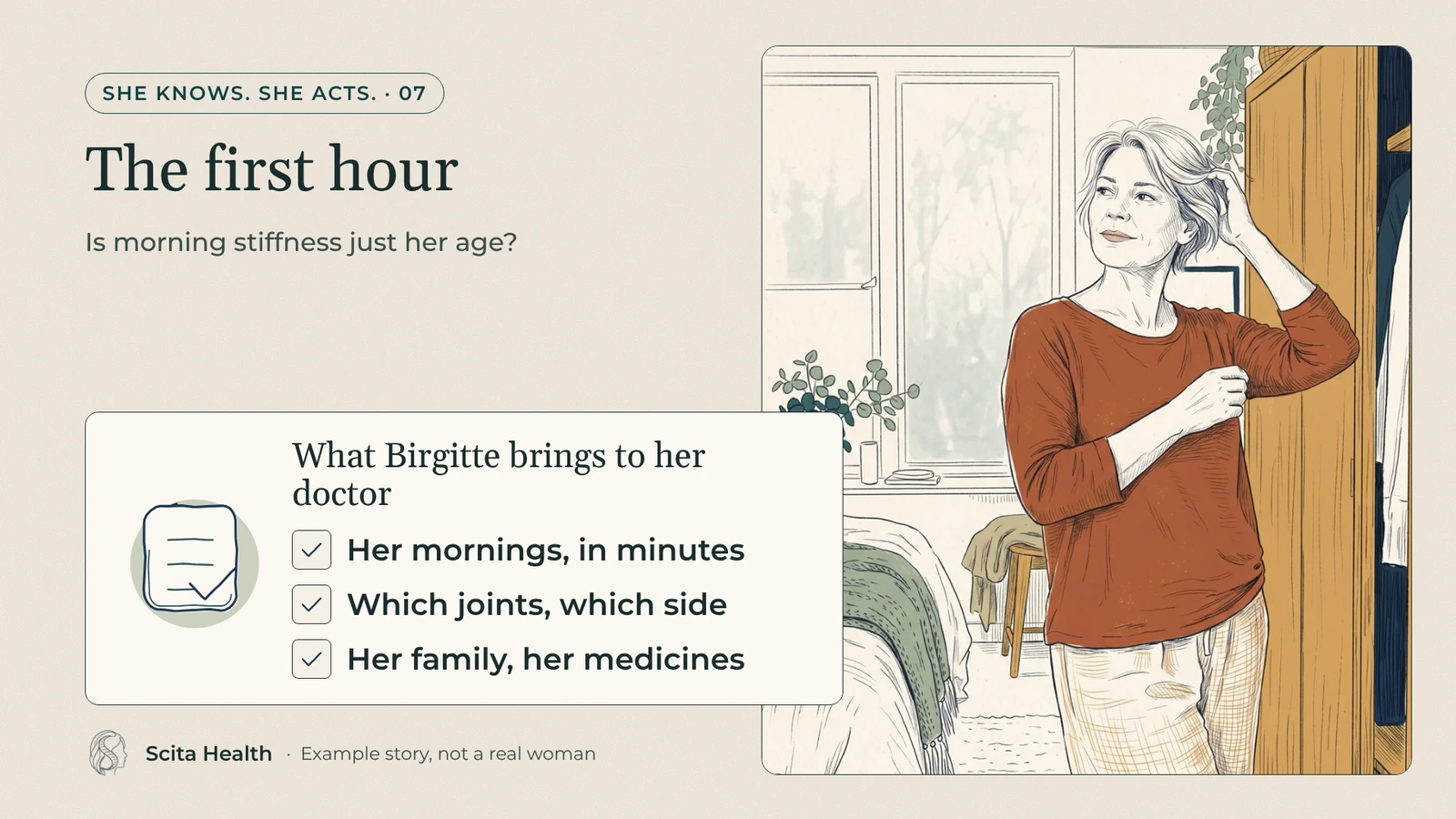
Is it her age?
Aching muscles and joints are common in these years. In a large Danish survey of women aged 45 to 59, two out of three of those going through or past the menopause transition reported tender muscles and joints, mild symptoms included.
This is what real women are saying:
"I went from running 6 miles a day plus weights to maybe 3 miles, and even that always left me sore, stiff and in pain."
"What drives me craziest is that I'm not doing anything more or different than in my 30s. I'm actually doing less and taking more rest days, and I'm still a stiff, injured mess."
"It felt like I aged 30 or 40 years overnight. I've seen 80-year-olds who seem more flexible than me. It isn't pain so much as my whole body feeling stiff and seized up, so badly that it really limits how I move. People say it's ageing, but I refuse to believe this is how it is in your mid-40s."
These women connect their symptoms to perimenopause. Birgitte is 55, and her stiffness began a couple of months ago, affecting her shoulders and hips for about an hour each morning. This pattern could have several possible causes.
The Danish doctors' handbook describes a pattern for polymyalgia rheumatica, an inflammatory condition. It includes pain and stiffness in both shoulders or both hips, stiffness that lasts more than 45 minutes after waking, being over 50, and signs of inflammation in a blood test. Trouble getting out of bed, getting dressed, or lifting the arms above the shoulders in the morning is typical of it. Not every part of the pattern has to be there, and doctors also check for other conditions that can look similar.
It almost never starts before age 50, and most people get it after 60, so 55 is a little young for this condition. Women are affected two to three times as often as men.
Rheumatoid arthritis, another inflammatory condition on her map, most often starts between ages 40 and 60, and women get it three times as often as men. It causes inflammation in the joints, especially the small joints of the hands and feet on both sides, and joint damage can begin a few weeks after symptoms start.
A 2026 review of five studies from the UK and Australia looked at how people experienced the road to a diagnosis of polymyalgia rheumatica. Many thought their first symptoms were just signs of getting older, which made them wait longer before seeking help. The review also mentioned earlier research where patients described feeling weak, while doctors focused on measuring morning stiffness.
What else it can be
Frozen shoulder is most common between ages 40 and 60, and seven out of ten people with it are women. The pain is in the shoulder joint, often worse at night, and after a few months, the shoulder gets harder to move.
An underactive thyroid can cause muscle and joint pain and stiffness, along with tiredness. Low vitamin D over a long time can make muscles tired and weaker, so getting up from a chair may mean using the hands, or climbing stairs can get harder. The handbook also lists medicine side effects to consider, like muscle pain from statins, which are used to lower cholesterol.
There isn't a single blood test that can confirm polymyalgia rheumatica or rheumatoid arthritis. Doctors look at her story, check her joints, and put that together with the blood tests. In polymyalgia rheumatica, CRP is usually high, but the sedimentation rate (ESR) can be normal at first. Rheumatoid factor is found in about 70 out of 100 people with rheumatoid arthritis, but also in about 5 out of 100 healthy people, so one test result alone doesn't give a clear answer. If tiredness or muscle weakness is the main issue, a Danish regional guide for GPs suggests also testing vitamin D, the thyroid (TSH), and a muscle enzyme (CK).
An appointment that counts
In Denmark she starts with her GP. In Sweden polymyalgia rheumatica is assessed at the vårdcentral. When rheumatoid arthritis is suspected, Danish guidance asks for a referral to a rheumatologist as soon as possible, and Swedish guidance within a week.
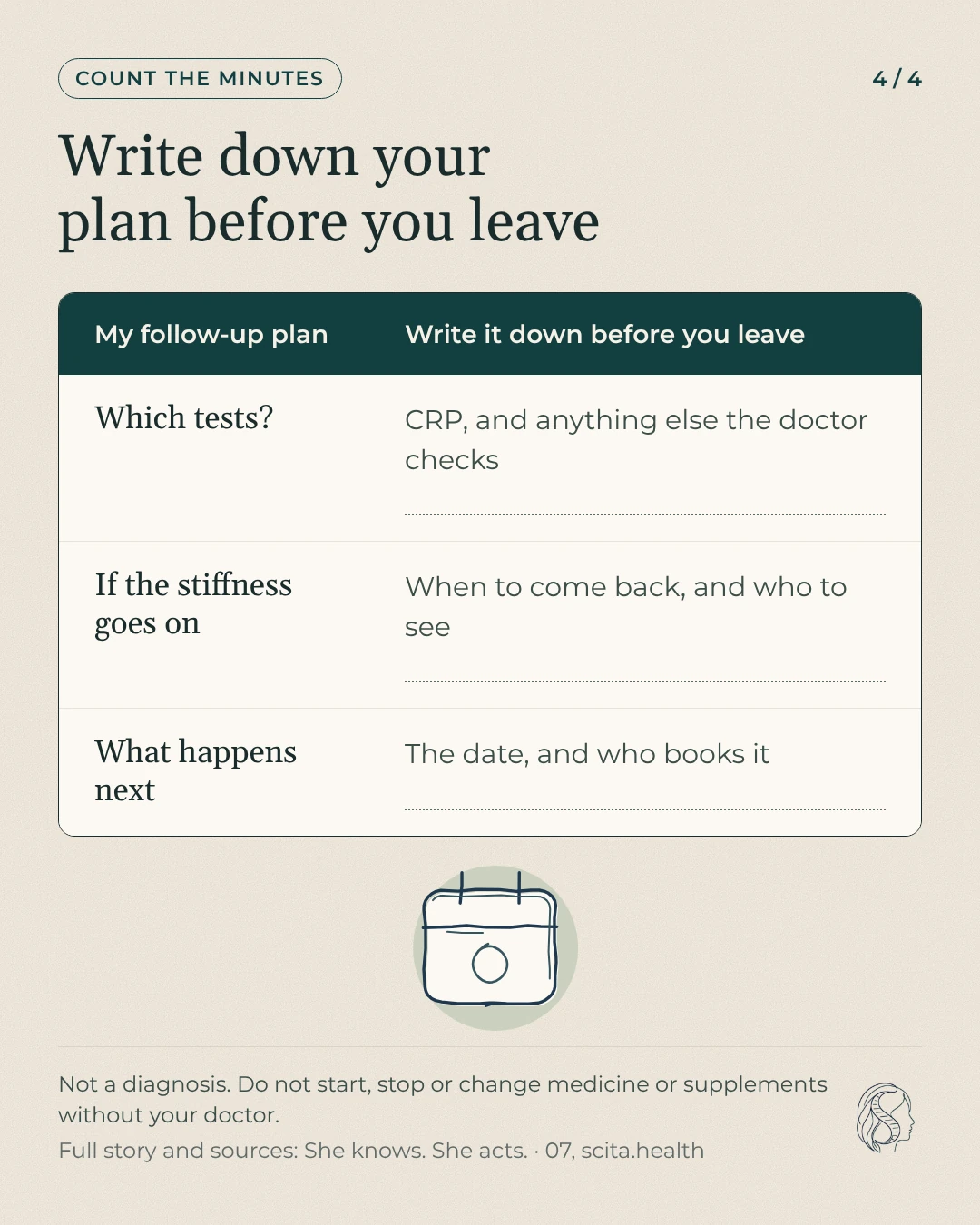
Doctors usually ask about the same things when checking for an inflammatory joint condition. Here are some notes that are helpful to bring:
- how many minutes the stiffness lasts each morning, and whether it is also worse after sitting still for a while;
- which places hurt or are stiff: neck, shoulders, upper arms, hips, thighs, hands or feet, and whether on both sides;
- when it started, and whether it came over a few days or slowly over months;
- what has become hard: lifting her arms, dressing, getting out of bed or up from a chair, the stairs;
- any painful, swollen or warm joints in the hands or feet;
- tiredness, fever or weight loss;
- any new headache, sore scalp, jaw pain when chewing or change in sight (these mean contacting a doctor at once, not waiting for the appointment);
- whether painkillers help;
- whether anyone in her family has a rheumatic disease;
- the medicines she takes.
She might call it tiredness or weakness. The doctor will want to know how many minutes the stiffness lasts each morning, so timing it can help. Someone at home can help with this.
She can begin her appointment by saying something like:
"For the last couple of months my shoulders and hips have been stiff for about an hour every morning, and I'm tired all day. My sister has rheumatoid arthritis. Could this be an inflammation rather than my age, and is a blood test for inflammation worth doing?"
What is changing
In Denmark, the rate of new diagnoses of polymyalgia rheumatica fell by 53 per cent in general practice and rose by 30 per cent in hospitals between 2003 and 2024. European recommendations updated in 2025 now say that everyone suspected of having this condition should see a specialist. The Danish doctors' handbook still lets GPs handle typical cases, bringing in a rheumatologist if things are unclear. The process can vary depending on where she lives, so she can ask about it.
Ultrasound can help with the assessment. In a study from Aarhus, Silkeborg, Horsens and Groningen, most people with polymyalgia rheumatica showed signs of inflammation on scans of their shoulders and hips. If the scan showed no signs, the diagnosis was unlikely. Similar signs can also show up in other inflammatory joint diseases. A rheumatologist arranges the scan.
Mette Hansen, Professor of Sports Science at Aarhus University, studies how women's hormones affect their muscles. In a 2025 review she led, she and her co-authors put forward the idea that exercise training started before or during the menopause transition may do more for muscle and the heart than training started years after menopause, though this idea is still being tested. We asked her what advice women can follow now.
"If you are not already meeting the general physical activity recommendations of muscle-strengthening exercise at least twice a week, now is a good time to start – the sooner, the better. ... there is no reason to wait until after menopause to start resistance training."
The WHO recommends doing muscle-strengthening activities on at least two days a week. If you have new pain or stiffness, talk to a doctor first.
Birgitte arrives early so no one sees her getting settled into her chair. Another woman, who has been stiff and in pain since 2019, wrote about feeling the same embarrassment and shared the goal that keeps her going:
"I used to be so embarrassed. Either I couldn't sit on the floor at all, or if I did, I couldn't get back up without help. That's what keeps me doing the movement: to be able to sit on the ground and get back up again on my own. Gotta have goals!!"
When not to wait
She should not start, stop, or change any medicine or supplement without her doctor.
A new headache, a sore scalp, pain in the jaw when chewing, or a change in sight, such as blurred or double vision or sight that goes for a moment, can be signs of giant cell arteritis, an inflammation of blood vessels that can come with polymyalgia rheumatica. These signs mean contacting a doctor at once: the Danish doctors' handbook says people with polymyalgia rheumatica should do so straight away, even during treatment, when such signs can still come, though rarely.
If sight suddenly changes, she contacts her doctor or an out-of-hours service at once, and goes to an emergency department if they are closed. Loss of sight is serious, and treatment in time can prevent it.
Tell me your story
Take a look at Birgitte's map, which shows her five symptoms, the fourteen possible explanations, and answers to her questions from medical sources. Scita meno is an open, educational map, not a diagnosis, and you do not have to share any personal health information to use it.
If you recognise yourself or someone you know in Birgitte's story, feel free to write to me at hello@scita.health. We will never publish your words without your permission, and we handle everything you send with care.
Next Sunday, 29 November, we will share Susan's story. She is 53, wakes up around three in the morning soaked in sweat, and has thought it was just a tough year.
Sources
- Scita meno, Birgitte's story, with the sources behind each link
- KiSO, Viden til kvinder (University of Copenhagen)
- Lægehåndbogen, Polymyalgia reumatica
- Patienthåndbogen, Polymyalgia reumatica
- Lundberg et al. 2022, Journal of Internal Medicine
- Patienthåndbogen, Leddegigt, oversigt
- Lægehåndbogen, Reumatoid artritis
- Yates et al. 2026, Rheumatology Advances in Practice
- Lægehåndbogen, Kapsulit, skulder
- Lægehåndbogen, Hypothyreose
- Lægehåndbogen, D-vitamin, mangel
- Viss (Region Stockholm), Polymyalgia reumatika och jättecellsarterit
- Region Hovedstaden, forløbsbeskrivelse: Polymyalgia reumatika
- 1177 för vårdpersonal, Polymyalgia reumatika
- 1177 för vårdpersonal, Reumatoid artrit
- 1177, Muskelreumatism
- Donskov et al. 2026, Arthritis & Rheumatology
- Mukhtyar et al. 2026 (the 2025 EULAR recommendations), Annals of the Rheumatic Diseases
- Våben et al. 2026, The Lancet Rheumatology
- Hansen et al. 2025, Exercise and Sport Sciences Reviews
- Bull et al. 2020 (WHO guidelines on physical activity), British Journal of Sports Medicine
- Lægehåndbogen, Kæmpecellearteritis
- Patienthåndbogen, Kæmpecelle arteritis
- 1177, Inflammation i tinningens pulsåder: jättecellsarterit
- Scita meno, the source library: every link on the map and the source it rests on