
SHE KNOWS. SHE ACTS. · 06 · HER STORY
The stairs at the station
Margrethe, 54, now pauses on the landing. Sometimes her chest flutters, and by evening one ankle is more swollen than the other.
Julia PerssonFounder, Scita Health5 min read

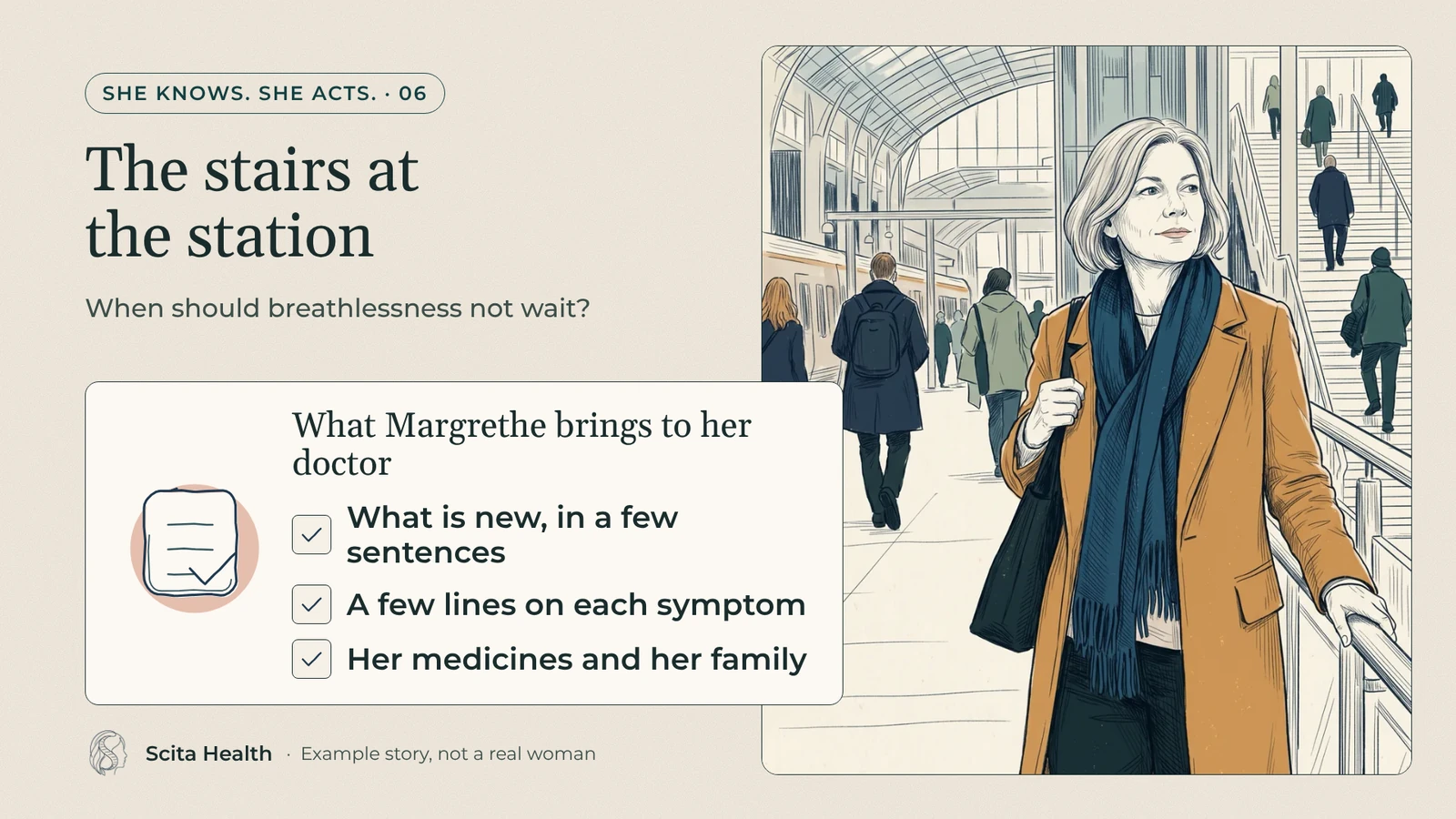
The stairs up from the platform used to be nothing. Margrethe took them every morning, bag on her shoulder and ticket still in her hand. This autumn she has caught herself stopping on the landing, waiting for her breath before the last flight, and looking at her phone as if that were the reason.
At work, she takes the lift and jokes about it before anyone else can. One day in the corridor, she mentioned being out of breath all week. A colleague thought she was talking about being unfit, and the conversation shifted to gym routines.
She keeps more to herself. Sometimes her heart flutters for a few seconds and she feels a bit dizzy, but then it passes, and she brushes it off. On the stairs, she feels pressure in her chest that goes away when she stops. In the evening, after taking off her socks, one ankle is more swollen. She also feels tired in a way that sleep doesn't fix. Each symptom alone seems too minor to call anyone about.
Margrethe is a composite character, created from many women's stories. She is the fifth of seven in this series from Scita meno, our free map of midlife symptoms.
What should not wait
Doctors treat new breathlessness or chest pain together with a newly swollen leg as an emergency, because a clot may have reached the lungs. For Margrethe, with breathlessness, pressure in her chest and a swollen ankle at the same time, that means calling 112 at once, and having someone stay with her until help arrives. It is not a reason to book an appointment.
Even on its own, a newly swollen leg is checked urgently, with an ultrasound, a blood test or both. Swelling in both legs usually comes from something affecting the whole body, like the heart or kidneys. Swelling in one leg usually has a cause in that leg, and a blood clot is one of them. A clot in the leg can give only mild discomfort, or few symptoms. On her map, an ankle that is puffier by evening counts as new swelling in one leg.
When she calls, she can say it in a few sentences:
"I've become breathless on the stairs, and that is new. I've had pressure in my chest when I climb them, my heart flutters sometimes and I feel dizzy, and one of my ankles has started to swell."
She can say plainly that the breathlessness is new, even if someone at work thought it meant she was unfit. She does not have to work out first what it is. The Danish patient handbook says it is "sundhedspersonalets opgave at finde ud af, hvor smerterne stammer fra", and not hers: finding out where the pain comes from is the job of the people treating her.
The signs that cannot wait, as her map lists them:
- Strong chest pain is a reason to call 112 straight away, without waiting, and so is chest pain or pressure that does not pass within five minutes at rest.
- A heart attack can also show as pain in the neck, jaw, shoulders, arms or back, sudden unexplained breathlessness, cold sweat, dizziness or fainting, or sudden nausea; not all of these need to be there.
- She should not drive herself to hospital.
- New breathlessness at rest, breathlessness with chest pain, and new breathlessness or chest pain with a newly swollen leg mean admission to hospital at once; with a swollen leg, a clot may have reached the lungs.
- Chest pain on effort that is new, or that comes with less and less effort, is assessed at a hospital heart department straight away.
- Fainting with a racing or fluttering heart, and chest pain with an irregular heartbeat, are reasons to call 112.
- A racing heart with dizziness or breathlessness leads to heart tests, even when a first ECG is normal.
- Atrial fibrillation is the most common cause of a stroke from a clot in the brain, so any sign that could be a stroke, such as one side of the face suddenly drooping, sudden weakness in an arm, or sudden difficulty speaking, means calling 112 at once.
- With known heart failure, the Swedish health service lists being very tired, finding it hard to breathe, tightness or pain in the chest, and cold sweat as reasons to call 112.
She should not start, stop, or change any medicine or supplement without her doctor.
A flutter, and the stairs
Some of her symptoms match menopause. Swedish guidelines include a racing heart as a hot-flush symptom, and the Danish doctors' handbook says hot flushes can come with a racing heart and a feeling of panic. In a US study of over 3,000 women, about half belonged to groups whose palpitations were most likely around perimenopause and just after, and less likely later.
But menopause is not the only possible cause, and a flutter that comes with dizziness is checked with heart tests. The same flutter can also come from low iron, thyroid problems or anxiety.
The stairs matter for a similar reason. Breathlessness with effort is common in heart failure, and people with angina get more breathless than before when they are active. Low iron can also cause it. Heavy periods are a common cause of low iron, but after menopause doctors look for other reasons. Chest pain on effort that is new is checked at a hospital straight away, and new or worsening breathlessness is assessed by a doctor, not just watched.
What is known about women's hearts
Chest pain or pressure is the most common sign of a heart attack or unstable angina in women, as it is in men: the Danish doctors' handbook puts it at more than 80 per cent in both sexes. A 2020 review of 27 studies found that women more often also had pain between the shoulder blades, nausea or vomiting, or breathlessness, with a large overlap between women and men.
The risk of heart disease rises with age, and clearly through the menopause. Angina can also come without a narrowed artery, from the heart's smallest blood vessels or from an artery that tightens in spasm. A European expert statement says this is more common in women, and that angina without a blocked artery is not harmless.
If it is not an emergency
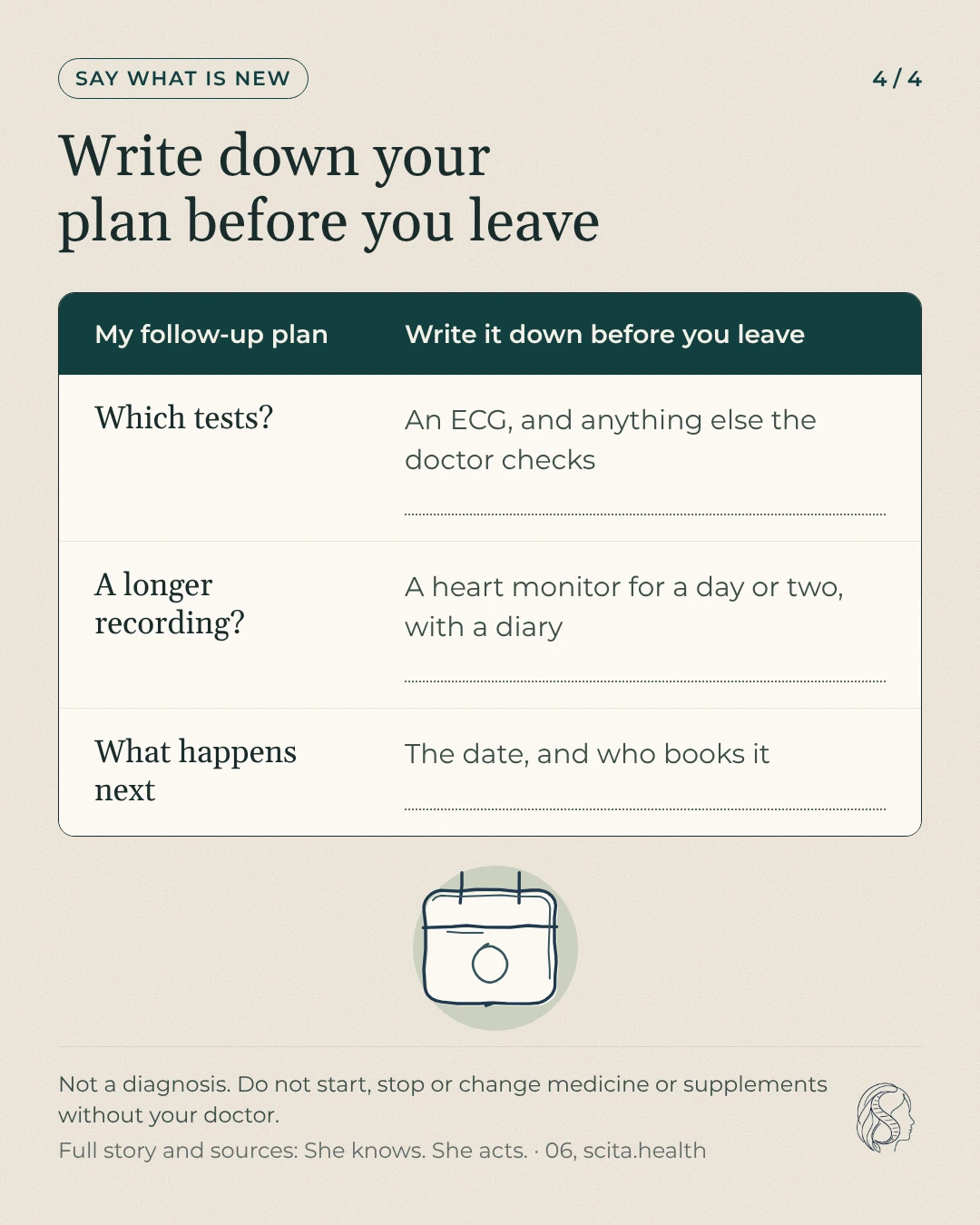
If a woman has none of the signs above, and there is time for a regular appointment, she starts with her GP in Denmark, or in Sweden with her vårdcentral if she is unsure what is causing the pain. For chest pain, the first test is a heart tracing (ECG), before any regular blood tests. Blood tests for suspected angina check for risk factors and other causes: blood count, salts, kidney function, blood sugar, cholesterol and thyroid. The heart itself is checked with an ECG, a heart CT scan or an ultrasound.
Writing down a few lines for each symptom helps the doctors who see her:
- the chest pain or pressure: where it is, what it feels like, what she was doing, how long it lasted and what made it pass;
- the breathlessness: how much effort brings it on, whether it is worse than a few months ago, and whether lying flat makes it worse;
- the flutters: when they start and stop, how long they last, whether the beat feels irregular, and any dizziness or fainting;
- the swelling: which leg, since when, and any pain, warmth or redness;
- her medicines, hormone therapy included, and any heart rhythm problems, fainting or sudden death in the family.
If she is given a heart monitor to wear for a day or two, she keeps a diary of her symptoms alongside it.
Many people wear watches that measure their pulse. A watch that records an ECG can in principle show atrial fibrillation, and most hospitals confirm this with a longer recording, such as two days with a portable ECG. A pulse reading taken with light, without an ECG, cannot be used to diagnose atrial fibrillation.
Tell me your story
See Margrethe's map: her five symptoms, the fourteen explanations they connect to, and her questions answered from medical sources. Scita meno is an open, educational map, never a diagnosis, and you do not need to share anything about your health to use it.
If you recognise Margrethe's story, in yourself or in someone close to you, write to me at hello@scita.health. We never publish anyone's words without asking first (how we look after what you send).
Next Sunday, 22 November, we will share Birgitte's story. She is 55 and finds her shoulders and hips are stiff for the first hour each morning.
Sources
- Scita meno, Margrethe's story, with the sources behind each link
- Lægehåndbogen, Lungeemboli
- Lægehåndbogen, Hævede ben
- Patienthåndbogen, Dyb venetrombose (DVT)
- Patienthåndbogen, Blodprop i hjertet, hvornår bør du søge læge?
- Patienthåndbogen, Blodprop i hjertet, symptomer
- Lægehåndbogen, Vejrtrækningsproblemer og åndedrætsbesvær
- Lægehåndbogen, Akut koronart syndrom
- 1177, Hjärtklappning
- Lægehåndbogen, Hjertebanken og uroligt hjerte
- Patienthåndbogen, Apopleksi, blødning eller blodprop i hjernen (førstehjælp)
- 1177, Hjärtsvikt
- Socialstyrelsen, Nationella riktlinjer 2026: Klimakteriebesvär
- Lægehåndbogen, Klimakteriet
- Carpenter et al. 2022 (SWAN), Menopause
- Lægehåndbogen, Hjertesvigt
- 1177, Kärlkramp
- Lægehåndbogen, Jernmangelanæmi
- van Oosterhout et al. 2020, Journal of the American Heart Association
- Kunadian et al. 2020, European Heart Journal
- 1177, Ont i bröstet
- Lægehåndbogen, Angina pectoris
- Lægehåndbogen, Atrieflimren og -flagren
- Scita meno, the source library: every link on the map and the source it rests on