
SHE KNOWS. SHE ACTS. · 05 · HER STORY
The body she thought she knew
Karin, 51, had diabetes in both her pregnancies. Now her shape, her appetite and her nights have changed, and she is thirsty at odd times.
Julia PerssonFounder, Scita Health6 min read
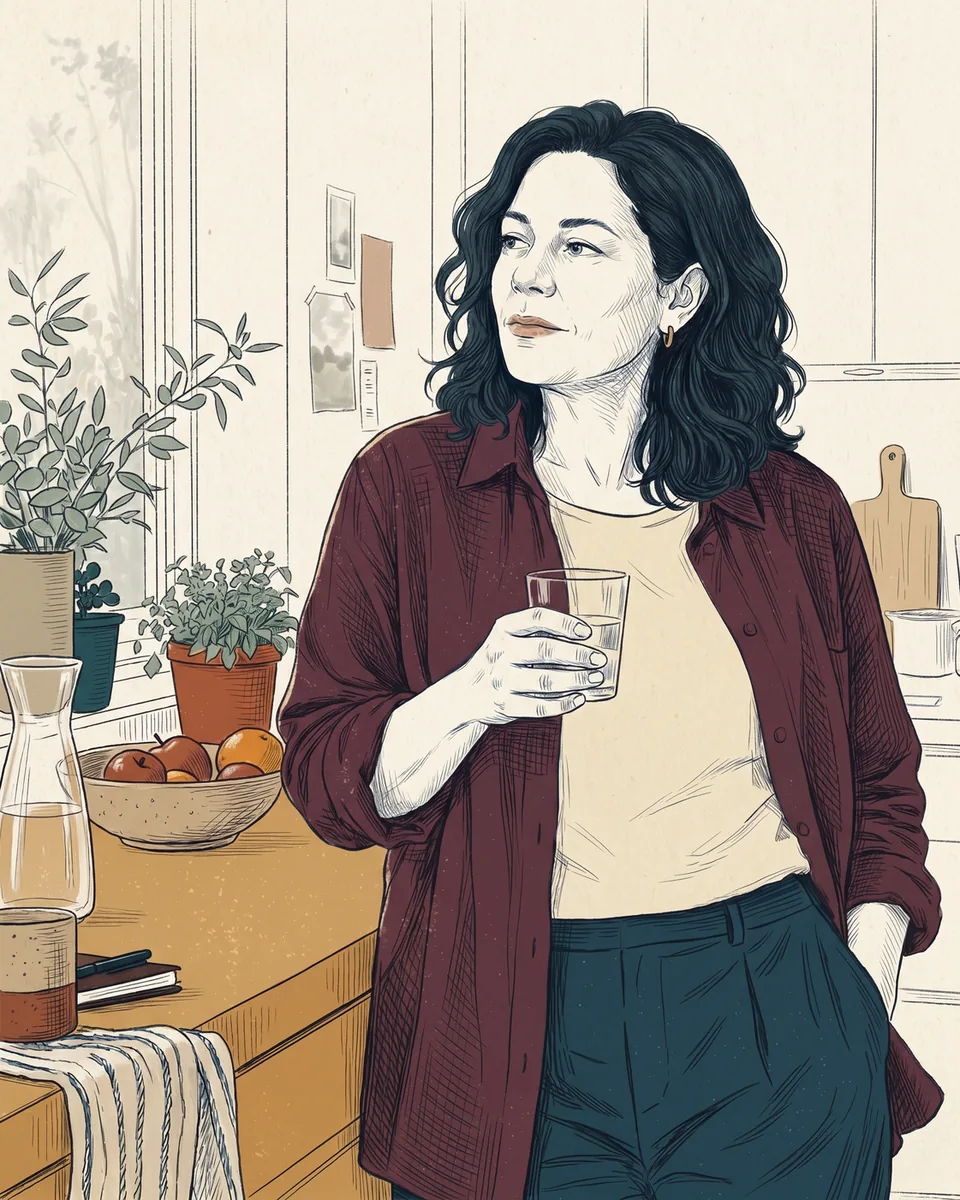
The white summer skirt will no longer close. Karin's weight has crept up slowly, and the jeans that used to take her through an evening at a restaurant now press into her stomach. In the shower, she looks down at her belly and is surprised again. A graze on her shin has not healed in weeks, and she is thirsty at odd times.
For years, she knew this body. On a hike, other people struggled to keep up, and after a holiday a few extra runs seemed to bring everything back into place.
Now, each morning, she makes a plan. Leave the cake at the office. Go for a walk after dinner. By evening, she is tired. She settles on the sofa, switches on the television and has a piece of cake. Sometimes another. It feels like one of the few pleasures left in a day that began with waking up tired.
On Instagram, there are diets and supplements. Her friends make suggestions about willpower. They mean well, and she still feels worse after hearing them.
Karin is a composite, built from many women's stories, and the fourth of seven in this series from Scita meno, our free map of midlife symptoms.
What the scales cannot show
During menopause, lower oestrogen changes where the body stores fat, and more of it gathers around the waist and deeper in the abdomen, near the organs. A woman's shape can change even if her weight does not change much. In a long-term US study that followed women with body scans, body fat started to increase faster as the menopause transition began, while lean tissue like muscle began to decrease. Yet weight kept rising at about the same rate as before.
Appetite can become unfamiliar too. In 2025, researchers brought together 40 women living in Ireland to talk about food and menopause. One participant said: "My appetite… I couldn't quench it. I was hungry all the time, even eating loads of protein… I wasn't satisfied." Some felt embarrassed to eat more around others and waited until they got home. These focus groups share experiences, but they do not show what causes them or how common they are. Sweden's healthcare guide, 1177, also recognises that hunger can increase during menopause.
A part of her story from twenty years ago
There's another thing in Karin's history actually. She had diabetes in both pregnancies, in 2004 and 2007, and her mother and her brother both have type 2 diabetes. Those pregnancies are long since forgotten in the timeline of her life. Medically they're still relevant.
A Danish study published in 2026 looked at 370 women who had diabetes in pregnancy many years ago. After some 30 years, around 40 per cent had been diagnosed with type 2 diabetes. That's a figure which applies to a particular cohort; Karin's own risk would require an individual assessment.
Insulin is a hormone that helps sugar enter cells. Sometimes the cells respond less well to it, and the body must make more insulin to compensate. Doctors call this insulin resistance, and fat stored deep inside the abdomen is associated with it. If the body can no longer make enough extra insulin, blood sugar rises, and type 2 diabetes can develop.
Early type 2 diabetes may cause few or no symptoms. Some people feel tired or just not themselves; others notice they are more thirsty or need to urinate more often, or that cuts heal slowly. A changing waistline, tiredness and cravings cannot diagnose diabetes. But Karin's pregnancy history gives her a clear reason to ask when her blood sugar was last checked and when it should be checked again. The Danish doctors' handbook advises a check every three to five years after pregnancy diabetes, and the same when a parent, brother or sister has diabetes.
An appointment with room for the whole story
For Karin, a helpful appointment would be the thing that would bring it all together: the changes she's seeing now, her pregnancies from years ago, her family history and any medicines she takes. In Sweden she can start at her local health centre, the vårdcentral; in Denmark the starting point is the GP.
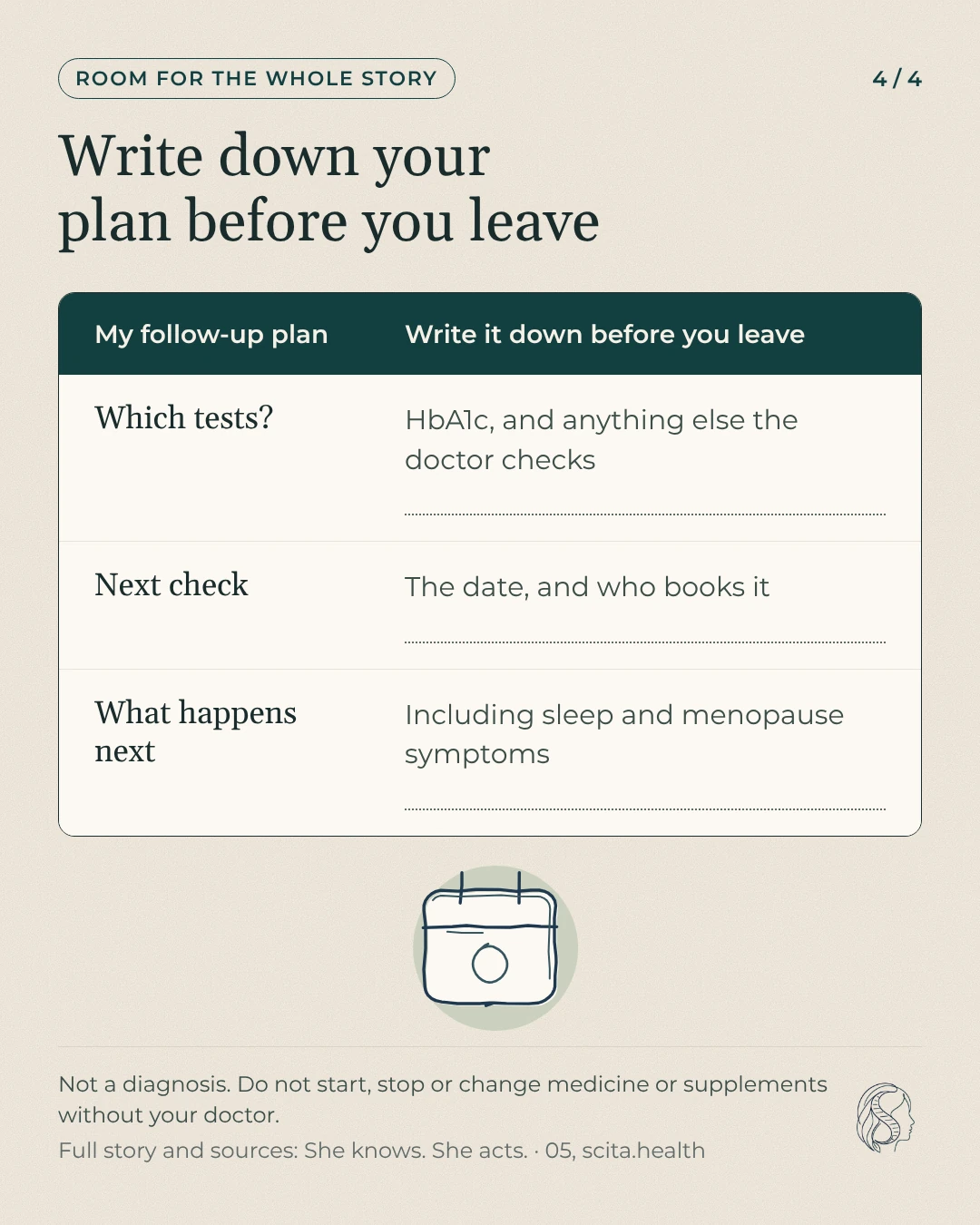
One of the common blood tests is the HbA1c. That gives an idea of her blood sugar over the previous two to three months. The doctor may also do a blood sugar test at the same visit, and an unexpectedly high result would usually be repeated to confirm it.
Denmark, Sweden and England recognise an HbA1c of 42 to 47 mmol/mol as increased risk or prediabetes, and the diabetes threshold is 48. Danish patient information on sundhed.dk also lists 31 to 44 as a normal laboratory range. The overlap can be confusing: a result of 43 may look reassuring and still deserve attention. Prediabetes does not mean diabetes is inevitable. It means there is a reason to discuss what could reduce the risk, and support with daily habits can lower it.
Her menopause symptoms also need attention during this assessment. Sweden's national menopause guidelines, published in April 2026, ask for staff who are informed, ask questions, listen and discuss options with each woman. They recognise that she may come in talking about poor sleep, low mood or aching joints.
New attention, and new offers
In Linköping and Kalmar, a Swedish study is comparing strength training and high-intensity cycling to no training for hot flushes and sweating, in women after menopause who do not already exercise regularly.
Women may also see glucose sensors marketed for perimenopause on their phones. Abbott's Lingo, sold in the UK and the US, uses a sensor on the upper arm to send glucose readings to an app, where the changes inside the body appear as a graph she can watch. A 2025 review notes that continuous glucose monitoring in people without diabetes is still of uncertain value, and found that public claims go beyond what medical research has shown. Before buying a new way to measure herself, a woman can ask what she would do with the information and whether it has been shown to improve health.
Something she can choose
Her first change should fit what she actually needs. If evening hunger is the problem, it can help to look at what happens earlier in the day, and regular, varied meals may help with hunger and sweet cravings between meals. If blood sugar is raised, a useful start is to reduce sugary drinks, choose wholegrain bread, rice or pasta in moderate portions so the meal still satisfies her, and add vegetables.
She can build movement into what she already enjoys. Walking, cycling, swimming and dancing all count. It's recommended to do activities that raise the breathing rate for at least two and a half hours a week, and exercises that work the muscles on at least two days, but any activity helps. In a small study of people with type 2 diabetes, advice to walk for ten minutes after each main meal helped blood sugar after meals more than advice to take one thirty-minute daily walk, most of all after the evening meal. Strength training helps keep muscles and bones strong in these years, also for women who already run or cycle.
A cooler bedroom may help with night sweats. If nights are still often broken, it's worth talking about what is waking her up and what treatment might help.
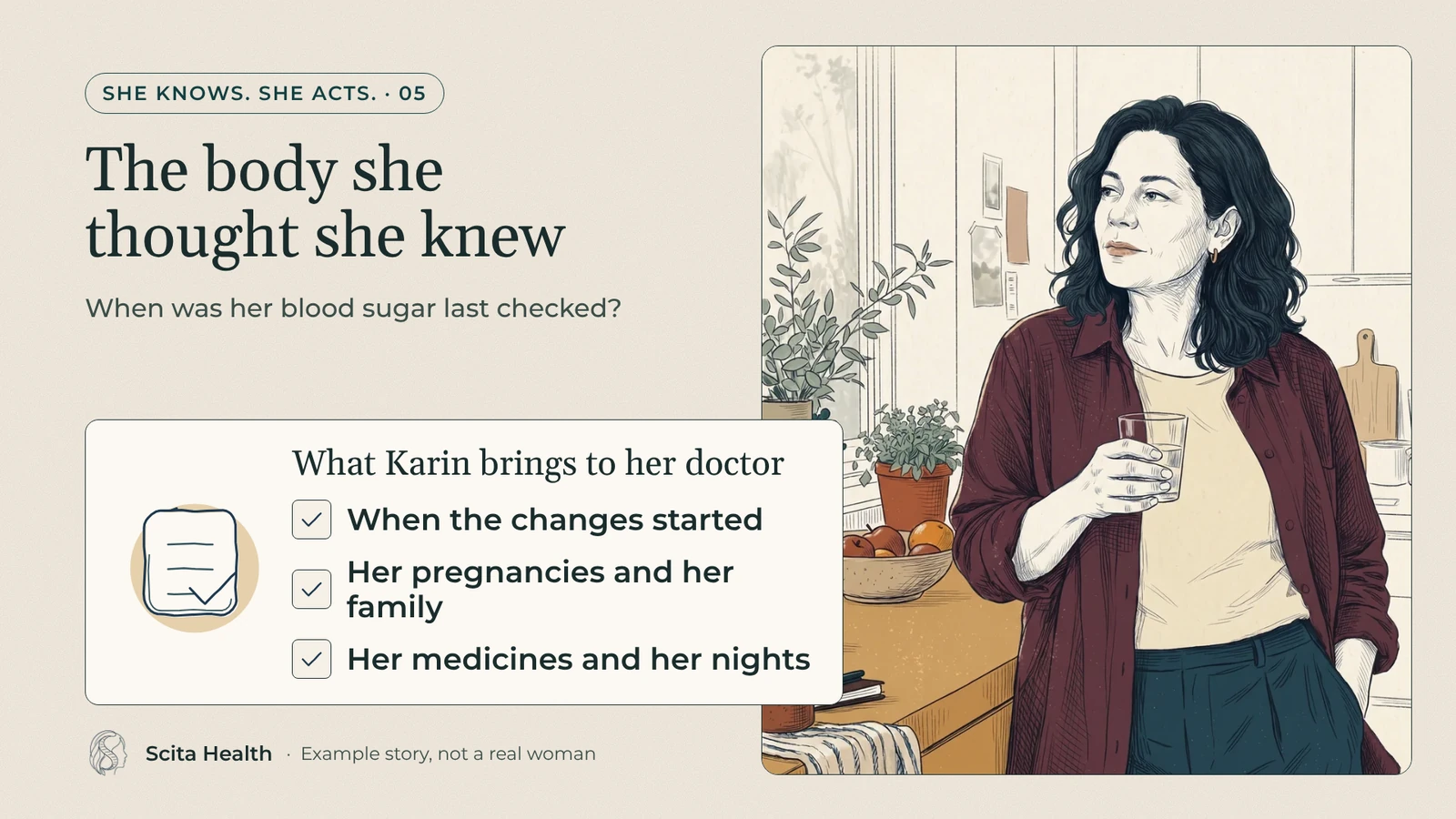
Feeling better matters, but a blood test is needed to assess blood sugar, and if her result is in the prediabetes range, she can agree when to repeat it. She can also bring some notes to her appointment, like when the changes started, what her nights are like, what medicines she takes, and what happened during her pregnancies. A way to open that conversation could be:
"My shape, appetite and sleep have changed, and I am often thirsty. I had diabetes in both my pregnancies, and my mother and brother have type 2 diabetes. Could we look at what might be contributing, and agree what happens next?"
When not to wait
She should not start, stop, or change any medicine or supplement without her doctor. Very high blood sugar can become dangerous within hours or days. Great thirst and passing water much more often than usual, with growing tiredness, mean contacting a doctor the same day, or the out-of-hours service when the practice is closed, rather than waiting for an ordinary appointment. Confusion, unusual drowsiness or being hard to wake are an emergency: call 112. This is rare, most often in people over 70, and it is life-threatening.
In someone with diabetes, a foot that suddenly becomes swollen, red and warm needs urgent hospital assessment, and a sore on the foot with a deep infection needs admission to hospital.
Tell me your story
We built Scita meno as an open, educational map, never a diagnosis. You can see how symptoms and explanations connect without sharing anything about your health. See Karin's map: her five symptoms, the seven explanations they connect to, and her questions answered from medical sources. With a free account, you can also read her story from the outside: in the Family & friends reading for the people at home, and in the Work reading for colleagues and managers.
Do you recognise Karin's story, in yourself or in someone close to you? Write to me at hello@scita.health. And if you are a researcher, doctor, or innovator whose work could help women like Karin, write to me too. What you tell us shapes the next editions. We never publish anyone's words without asking first, and you decide whether your name goes with them (how we look after what you send).
Next Sunday: Margrethe, 54, who has started to notice the stairs at the station.
Sources
- Scita meno, Karin's story, with the sources behind each link
- 1177, Klimakteriet: vad händer i kroppen?
- Greendale et al. 2019 (SWAN), JCI Insight
- O'Donovan et al. 2025, Nutrients
- Jørgensen et al. 2026, Diabetologia
- Lægehåndbogen, Metabolisk syndrom
- Patienthåndbogen, Type 2-diabetes
- Patienthåndbogen, Hyperglykæmi ved type 2-diabetes
- Lægehåndbogen, Type 2-diabetes
- 1177, Diabetes typ 2
- Patienthåndbogen, HbA1c
- 1177 för vårdpersonal, Diabetes, utredning
- NICE, Indicator IND171: non-diabetic hyperglycaemia and the diabetes prevention programme
- Socialstyrelsen, Nationella riktlinjer för vård vid klimakteriebesvär: information till patienter
- ClinicalTrials.gov, NCT06030388 (START, Linköping and Kalmar)
- Linköping University, Kvinnor sökes till studie med träning som behandling mot klimakteriebesvär
- Lingo, Perimenopause and menopause
- Medtech Insight, Abbott's Lingo debuts in the UK
- Abbott, Lingo enters the US consumer market
- Avner and Robbins 2025, Clinical Medicine Insights: Endocrinology and Diabetes
- 1177, Råd för att må bra under klimakteriet
- Svensk sjuksköterskeförening, Stöd och råd vid prediabetes
- Bull et al. 2020 (WHO guidelines on physical activity), British Journal of Sports Medicine
- Reynolds et al. 2016, Diabetologia
- Patienthåndbogen, Diabetes, akutte situationer
- Scita meno, the source library: every link on the map and the source it rests on