
SHE KNOWS. SHE ACTS. · 03 · HER STORY
Lene's late evenings, and the review her manager almost wrote
Lene stays late because it is the only time she can concentrate, and still she falls behind. Her manager is about to score her low. Perimenopause, ADHD that was there all along, or both?
Julia PerssonFounder, Scita Health8 min read
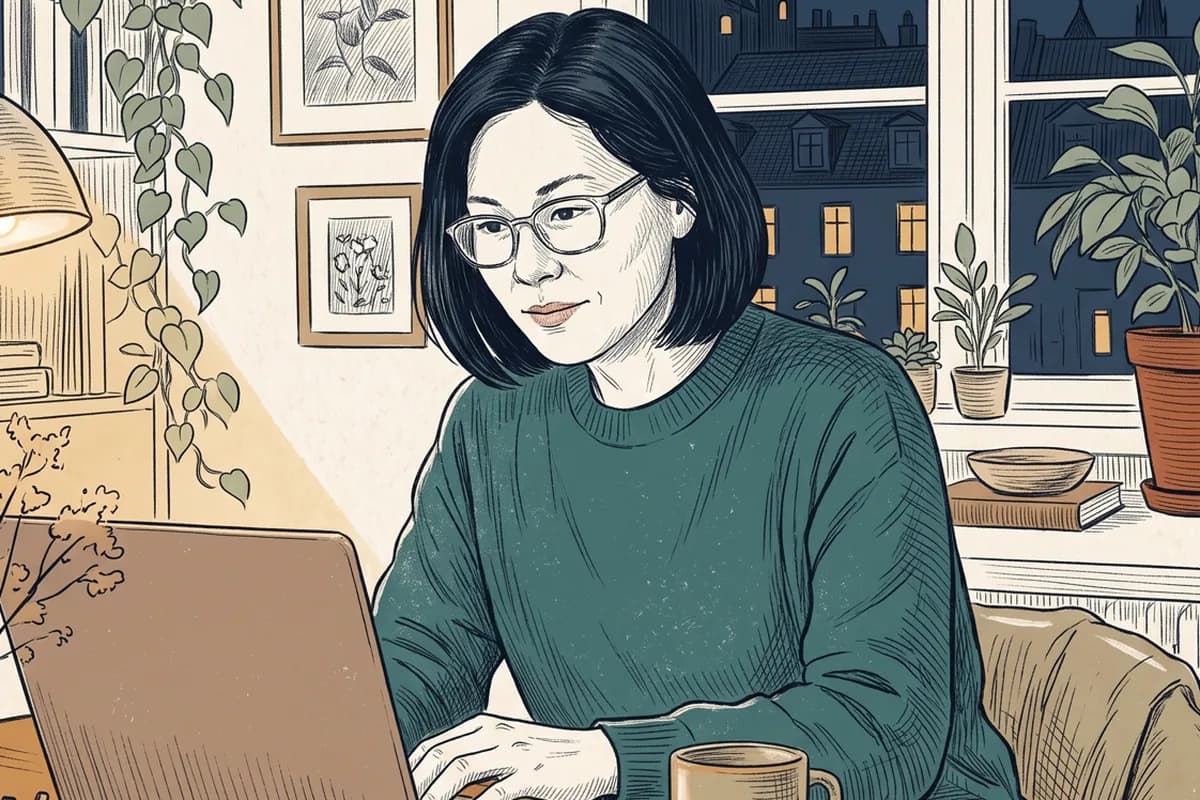
Lene is 46. For twenty years, she has been the one colleagues bring the tangled problems to. She sees where a project will go wrong before anyone else does.
Lately, she does not feel like herself. Things she used to enjoy have gone flat. She loses her temper faster than before. Concentrating has always been hard, but now it feels impossible. Words go missing mid-sentence, and her sleep is broken. At home, her partner sees the change too, and does not know how to ask.
At work, she has become hard to predict. That is what her team notices, not the exhaustion behind it. She works late, alone, because it is the only time she can concentrate. Still she falls behind. Reports start well and stall halfway. The call she promised to return does not happen.
Her colleagues have always found her a little "barsk", as we say in Scandinavia: stern. She has never coped well with people talking and laughing while she tries to work.
Many times at work I have heard PMS or menopause used as an accusation, as another way of calling a woman difficult. Women are blamed for what they are going through, and because no one, including themselves, knows what it is, it must be their fault.
Her manager, Mikkel, is preparing her performance review. On paper, she would score low. But this is not the Lene he knows. So before he writes anything down, he wonders how to talk to her about it, and what could help, without guessing at the reason.
Lene and Mikkel are fictional, composite portraits built from many women's stories and the people around them. Lene's is the second of seven stories on Scita meno, our free map of midlife symptoms.
What research knows: when it was there all along
Being easily distracted by what goes on around you is one of the recognised signs of ADHD. What her colleagues read as personality may have been there long before menopause.
ADHD does not start at 46. It is a neurodevelopmental condition, and its difficulties start in childhood. In women it can go unrecognised for decades, partly because many learn ways to compensate, such as perfectionism.
Then the hormones change. Oestrogen interacts with dopamine, the signalling system most ADHD medication works on. In 2026, Dora Wynchank and Sandra Kooij, ADHD specialists in The Hague, wrote that perimenopause and menopause can worsen or unmask ADHD that was already there (Wynchank and Kooij, 2026). The strategies that carried a woman through her working life can stop being enough.
How often this happens is still unclear. A 2025 European review calls what we know "relatively limited", and notes that no study has yet followed how women with ADHD concentrate and plan across the menopause transition (Kooij and colleagues, 2025).
An Icelandic study asked 5,392 women aged 35 to 55 about their symptoms. Women who said they had ADHD reported severe perimenopausal symptoms far more often: 54.2 per cent against 30.1 per cent. The gap was largest at ages 35 to 39 (Jakobsdóttir Smári and colleagues, 2025).
"Our results indicate that women with ADHD may start to experience symptoms of perimenopause from an earlier age than those without ADHD. Moreover, their ADHD symptom burden may increase during the perimenopausal period."
Unnur Jakobsdóttir Smári, psychologist and PhD student at the Centre of Public Health Sciences, University of Iceland, who led the study
The authors are careful. They measured the women once, so they cannot show that ADHD causes a harder perimenopause. And women with ADHD scored high on the questionnaire at other ages too, so in their words it "may not exclusively be measuring perimenopausal symptoms".
Not every study agrees. A King's College London survey of 656 women found no statistically significant difference in menopausal complaints between women with and without ADHD, although across all the women, ADHD symptoms and menopause complaints rose together (Chapman and colleagues, 2025).
That overlap is what makes it hard for everyone, her doctor included. Brain fog, forgetfulness, broken sleep, irritability and anxiety are menopause symptoms too.
So what is established? That ADHD begins in childhood and lasts. What is still emerging is whether perimenopause makes it worse in women with ADHD. Many women describe it, but the studies disagree, and each asked women only once.
And it is not only these two. On Lene's map, her six symptoms connect to ten possible explanations. Adult ADHD, perimenopause, and depression or anxiety each match at least four of them. A thyroid problem, sleep apnoea and low vitamin B12 match three each.
What is changing: work that adapts without asking why
In September 2026, ISO published ISO 45010, the first international standard on menstruation and menopause at work (ISO). In Denmark, Dansk Standard has published a free guide on menopause at work, based on the standard (Dansk Standard).
Its approach fits Lene: a workplace does not need to know the reason to help. It can change the conditions she works in, and ask about the work, not her health.
Unnur Jakobsdóttir Smári sees the same need in her clinical work with women with ADHD, rather than in the study:
"General education on the consequences of perimenopause and on ADHD would be helpful, with emphasis on possible ADHD-friendly adaptations at the workplace to help increase productivity and wellbeing, and to possibly prevent adverse outcomes such as stress, anxiety and perhaps burnout."
So Mikkel talks to Lene before the review, not in it. Inside a review, even a soft question sounds like a verdict. He tells her what he has noticed, as an observation, not an accusation, and asks whether she sees it too.
She does. The open office is the hardest part, she says. In the noise she cannot hold a thought, which is why she stays late. She asks for the small meeting room on the days she writes reports. Mikkel says yes, and they agree to look at it again in six weeks.
He does not ask why, and she does not have to say. His review records the work as it is, next to the change they have made and the date they will look at it again.
If one day she wants to tell him more, his doors are the workplace ones: occupational health, or HR. The doctor is her door, not his.
This is also why it matters that Mikkel asks first. A friend told me a sad story recently. She was very stressed at her new job, and she thought she might have been going through perimenopause, but it was impossible to say, because the pressure at work kept mounting and there was no way to separate what was what. She also had brain fog and significant sleep problems, and was on her third kind of sleeping medicine that did not work. She held up as long as she could, and then she simply crashed and went on sick leave for stress. When she came back, she was told she had not performed well enough, and she was fired. She feels it was punishment for the sick leave, which her manager saw as weakness and as letting the team down.
Later, a professor of neurology told her that perimenopause had very likely made her problems significantly worse, and that she might not have gone down with stress if she had not been in perimenopause.
This is her story, and I know just one side of it: I have never heard from her manager. But a person who does not know what is happening to her, who does not feel well, and who is fired after a sick leave, perimenopause or not - that should not happen. The difference between her story and Lene's is that Mikkel asks while there is still time.
My friend's story is real. She read it and agreed to it being shared, without her name.
What care does today
If Lene sees her doctor, there is more than one thing to look at.
- ADHD is assessed by looking back. Its difficulties start in childhood and get in the way in more than one part of life, such as at home and at work. So the key question is whether it has always been like this. In adults, the assessment is usually a specialist's work, and the doctor decides whether a referral makes sense.
- Perimenopause, after 45, is recognised from her periods and symptoms. No hormone test is needed, says the Danish doctors' handbook.
- The look-alikes are checked one by one. Depression and anxiety are part of the conversation. A thyroid problem and low vitamin B12 can be checked with an ordinary blood test. Broken sleep with snoring or pauses in breathing can point to a sleep study. The doctor decides what applies.
Where research stops: if ADHD is diagnosed, there are no randomised trials yet of ADHD treatment in women in perimenopause or menopause. Care at this stage rests on expert agreement (Wynchank and Kooij, 2026).
What she can do today: She knows. She acts.
A woman in Lene's place does not need to diagnose herself before she sees her doctor. The doctor decides what applies. What she can bring is clarity.
- Look back. Has it always been like this? School reports, and what her parents or siblings remember, can tell her doctor more than how she feels this month.
- Simple notes, kept day by day. Her mood, her sleep, when concentration goes, and the dates of her periods.
- What the people around her have seen. Her partner noticed the change at home. She can bring that too.
- One direct question. "Could this be ADHD that has been there all along, as well as perimenopause, and what else should we check?"
- At work, she decides what to share. She can ask for changes to how she works without giving a reason.
Explore the map, and tell me your story
We built Scita meno as an open, educational map, never a diagnosis. You can see how symptoms and explanations connect without sharing anything about your health.
See Lene's map: her six symptoms and the ten explanations they connect to. Her questions, answered from medical sources, follow soon. With a free account, you can also look at her story from the outside: in the Family & friends reading, for the people at home, and in the Work reading, for a manager like Mikkel.
Tell me your story. Have you, or someone close to you, been called difficult at work, before anyone knew what was going on? Write to me at hello@scita.health.
Share your work. If you are a researcher, doctor or innovator whose work could help women like Lene and the people around them, write to me too.
What you tell us shapes the next editions. The more patterns we name out loud, the fewer women have to guess alone. We never publish anyone's words or details without asking first, and you decide whether your name goes with them (how we look after what you send).
Next Sunday: Mette, 49, tired all the time and losing words, in what everyone calls a busy year.
Sources
- Scita meno, Lene's story, with the sources behind each link
- Jakobsdóttir Smári U et al. Perimenopausal symptoms in women with and without ADHD. European Psychiatry 2025;68(1):e133
- Chapman L et al. Examining the link between ADHD symptoms and menopausal experiences. Journal of Attention Disorders 2025;29(14):1263-1277
- Kooij JJS et al. Research advances and future directions in female ADHD. Frontiers in Global Women's Health 2025;6:1613628
- Wynchank D, Kooij S. Pharmacological management of ADHD in women across perimenopause, menopause and post-menopause. Drugs and Aging 2026;43(5):385-395
- Lægehåndbogen, Hyperkinetiske forstyrrelser/ADHD
- 1177 för vårdpersonal, Adhd
- Lægehåndbogen, Klimakteriet
- ISO 45010:2026, Menstruation and menopause in the workplace: guidance
- Dansk Standard, Guide om overgangsalder på arbejdspladsen (DS-hæfte 68:2026)
- Further reading: Bijlenga D et al. Atypical sensory profiles as core features of adult ADHD. European Psychiatry 2017;43:51-57
- Further reading: Greendale GA et al. Effects of the menopause transition and hormone use on cognitive performance in midlife women (SWAN). Neurology 2009;72(21):1850-1857
- Scita meno, the source library: every link on the map and the source it rests on