
SHE KNOWS. SHE ACTS. · 02 · HER STORY
Hanne's broken nights, and what Claus hears in the dark
Night sweats, broken sleep and a crash every afternoon. Everyone puts it down to menopause. Then Claus hears Hanne stop breathing in the dark. Why it can be two things at once, and how doctors tell them apart.
Julia PerssonFounder, Scita Health6 min read
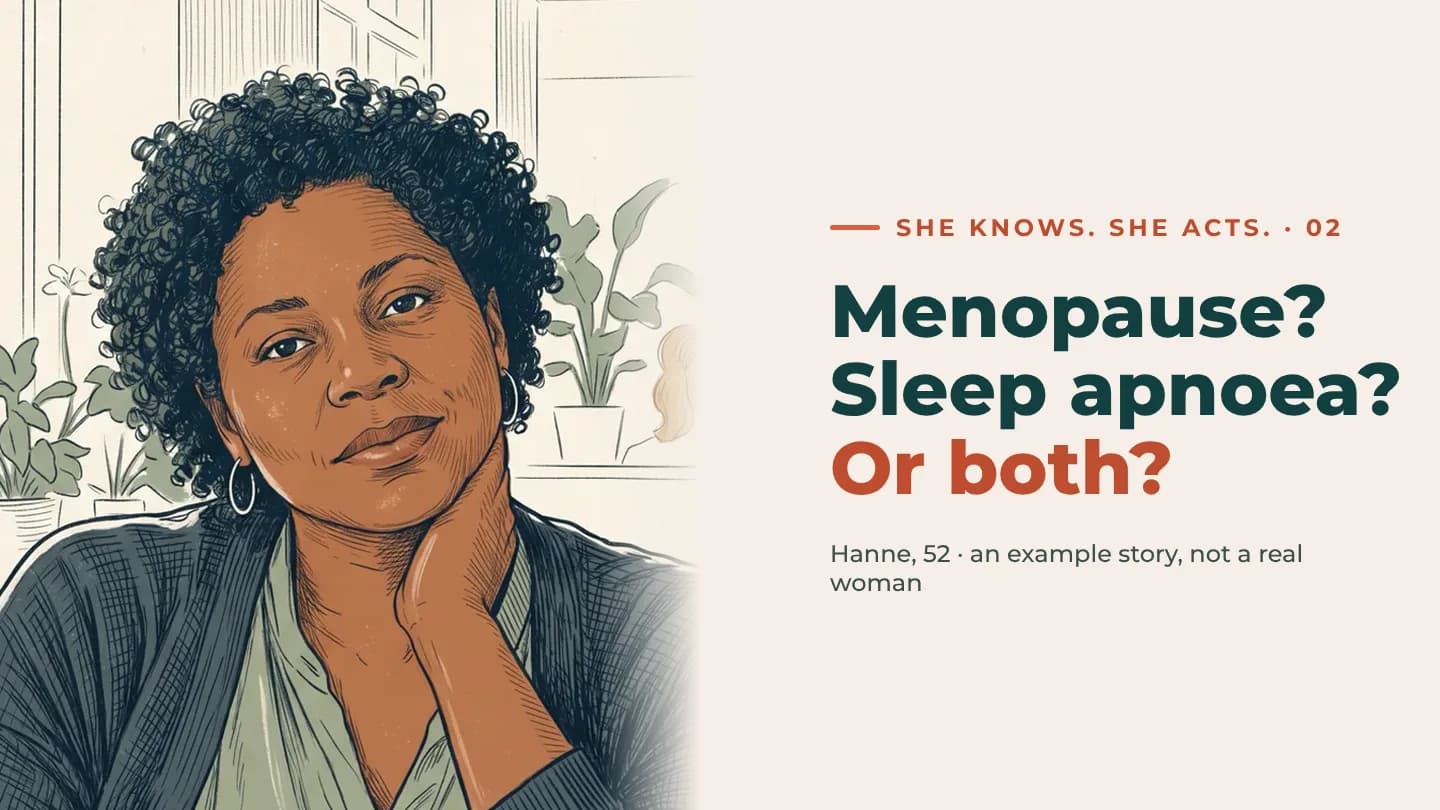
Hanne is 52. Every night she is awake at three, throwing off the duvet in a sweat. By three in the afternoon she is completely spent.
At work, she is sharp in the morning and gone by two. Her colleagues have quietly learned to catch her before lunch. Someone has started calling her unreliable in the afternoons. Nobody asks her how she is sleeping.
When a woman in her fifties loses stamina or patience, the world is quick to see a flaw in her character. It blames her attitude, her stress or "her hormones". No one, including Hanne herself, knows what is actually happening in her body. So she carries the blame for it.
She puts her exhaustion down to the night sweats. So does everyone else.
It is her husband, Claus, who notices what she cannot. Lying awake beside her, he hears her stop breathing for a quiet moment in the dark. Then she gasps for air.
Neither of them knows what it means. Both of their nights are broken by it.
Hanne and Claus are fictional, composite portraits built from many women's stories. Hanne's is the first of seven stories on Scita meno, our free map of midlife symptoms.
What research knows: when "just menopause" is two things at once
Night sweats, broken sleep and exhaustion that sleep does not fix can all come from perimenopause and menopause.
They can also come from obstructive sleep apnoea. During the night, the upper airway narrows or closes for a moment. The sleeper half wakes to breathe again, usually without remembering it in the morning.
On the Scita meno map, Hanne's four symptoms match sleep apnoea (all four) and perimenopause (three of four). It does not have to be one or the other. It can be both.
For decades, sleep apnoea has been treated as a man's illness. The Danish doctors' handbook, Lægehåndbogen, estimates that it affects 10 to 20 per cent of men and 5 to 9 per cent of women aged 30 to 60.
After menopause, it becomes more common in women, and the gap with men narrows. In a US study, women's sleep was recorded at home several times (Mirer and colleagues, 2017). Women after menopause had more breathing pauses and shallow breaths per hour than women before it. That held even after accounting for age, weight, and waist and neck size.
Why is it easy to miss in women like Hanne? Women often do not present like the textbook patient. Instead of loud snoring and nodding off in chairs, they more often describe restless, broken sleep, crushing daytime tiredness, low mood, morning headaches or nightmares.
All of that sounds like menopause, or burnout. As the researchers behind the US study point out, putting sleep problems down to menopause can leave a treatable sleep disorder undiagnosed.
And the overlap does not stop there. On Hanne's map, her four symptoms connect to 14 possible explanations. Seven of them can be checked with an ordinary blood test, from a thyroid problem or low iron stores to low vitamin B12, low vitamin D or raised blood sugar.
We deserve to know which of them applies, not guess in the dark.
What is changing: can a smart ring or watch catch what Claus hears?
When a woman suspects her sleep is broken by more than night sweats, it is natural to ask: can the technology on her wrist or finger tell her what is happening?
On 20 July 2026, the US Food and Drug Administration cleared a new version of Samsung's sleep apnoea feature for its smart ring and watch (FDA, K261011). It is designed to flag signs of moderate to severe sleep apnoea. It does not diagnose it.
For someone like Hanne, that sounds like an easy first check. Until you look at the validation data inside the clearance. Tested against sleep studies in a laboratory:
- the watch picked up 84.7 per cent of cases in women, and 94.1 per cent in men;
- the ring picked up just 63.2 per cent of cases in women, and 85.5 per cent in men.
So the ring missed more than a third of the women who had moderate to severe sleep apnoea. The clearance does not say why.
What it does say is that users "should not use this feature to replace traditional methods of diagnosis and treatment by a qualified clinician". A "normal" result on a ring should never be used to dismiss what Claus hears at three in the morning.
The clearance is American. It says nothing yet about the Nordics.
What care does today
Across the Nordics, health authorities are beginning to close the midlife knowledge gap.
In Sweden, Socialstyrelsen published the final version of its national guidelines on menopause symptoms on 16 April 2026. They list sleep problems among the symptoms and ask primary care to give advice on sleep (Socialstyrelsen).
Here in Denmark, on 9 October 2026, the health minister asked Sundhedsstyrelsen to bring all the relevant parties together in a national effort on menopause, with Medicinrådet and the Danish College of General Practitioners (DSAM). National clinical recommendations are expected during 2027. Sleep is among the symptoms the announcement names (Sundhedsstyrelsen).
So if Hanne books a consultation today, how does her doctor tell these conditions apart?
- Perimenopause, after 45, is recognised from her periods and symptoms. No hormone test is needed, says the Danish doctors' handbook. Sweden's new guidelines advise against a routine FSH test at that age. Hormones swing, sometimes from one day to the next. A single result is only a snapshot of a moving target.
- Some look-alikes are checked with an ordinary blood test. For tiredness like Hanne's, the sources name TSH and free T4 for the thyroid, and a full blood count with ferritin, read together with CRP, for iron stores. The doctor decides what applies.
- Sleep apnoea is checked with an overnight recording. Questionnaires about snoring and daytime sleepiness help a GP decide who needs testing. But only a sleep study can show sleep apnoea. In Denmark, the GP refers her for a recording of her breathing with small portable sensors, in her own bed.
- Waiting times differ. In Sweden, most people get the result within a month. In Denmark, Lægehåndbogen notes that many ear, nose and throat clinics have a wait of several months for the study itself. All the more reason to ask early.
What she can do today: She knows. She acts.
A woman in Hanne's shoes does not need to diagnose herself before a 10-minute GP appointment. The doctor decides what applies. What she can bring is clarity.
- One week of simple notes. When her sleep breaks, and why. When the afternoon exhaustion hits. The dates of her periods.
- What Claus has seen. Pauses in breathing and gasping, seen by someone else, are among the signs doctors ask about when deciding on a sleep study. Claus can write down a few sentences about what he hears at night, or come along.
- One direct question. "Could my exhaustion be sleep apnoea as well as perimenopause, and is a sleep study worth doing?"
- One safety rule. If she has ever nodded off while driving or in the middle of the day, she should tell her doctor. And she should not drive while she is this tired.
Explore the map, and tell me your story
We built Scita meno as an open, educational map, never a diagnosis. You can see how symptoms and explanations connect without sharing anything about your health.
See Hanne's map: her four symptoms, what they connect to, and her questions answered. It is open to everyone. With a free account, you can also look at her story from the outside: in the Family & friends reading, for the person who sees her nights, and in the Work reading, based on Dansk Standard's guide on menopause at work.
Tell me your story. Have you, or someone close to you, lived through a midlife symptom that was put down to "just hormones" or "just stress", before the real pattern was found? Write to me at hello@scita.health.
Share your work. If you are a researcher, doctor or innovator whose work could help women like Hanne and the people around them, write to me too.
What you tell us shapes the next editions. The more patterns we name out loud, the fewer women have to guess alone. We never publish anyone's words or details without asking first, and you decide whether your name goes with them (how we look after what you send).
Next Sunday: Lene, 46, when a flat mood, a short temper and a sudden loss of focus collide.
Sources
- Scita meno, Hanne's story, with her questions answered and the sources behind each answer
- Lægehåndbogen, Obstruktiv søvnapnø
- Patienthåndbogen, Obstruktiv søvnapnø syndrom
- 1177 för vårdpersonal, Obstruktiv sömnapné hos vuxna
- 1177, Att mäta andningen när du sover
- Mirer et al. 2017 (Sleep in Midlife Women Study), Menopause
- Bouloukaki et al. 2021, Medical Principles and Practice
- Perger et al. 2019, Maturitas
- US FDA, 510(k) K261011, Samsung Sleep Apnea Feature v2.0, decision summary (20 July 2026)
- Socialstyrelsen, Nationella riktlinjer 2026: Klimakteriebesvär, final version (16 April 2026)
- Sundhedsstyrelsen, Ny fælles indsats skal styrke viden om overgangsalderen (9 October 2026)
- Lægehåndbogen, Klimakteriet
- Patienthåndbogen, Lavt stofskifte (hypothyreose)
- Lægehåndbogen, Ferritin
- Dansk Standard, Guide om overgangsalder på arbejdspladsen (DS-hæfte 68:2026)
- Scita meno, the source library: every link on the map and the source it rests on